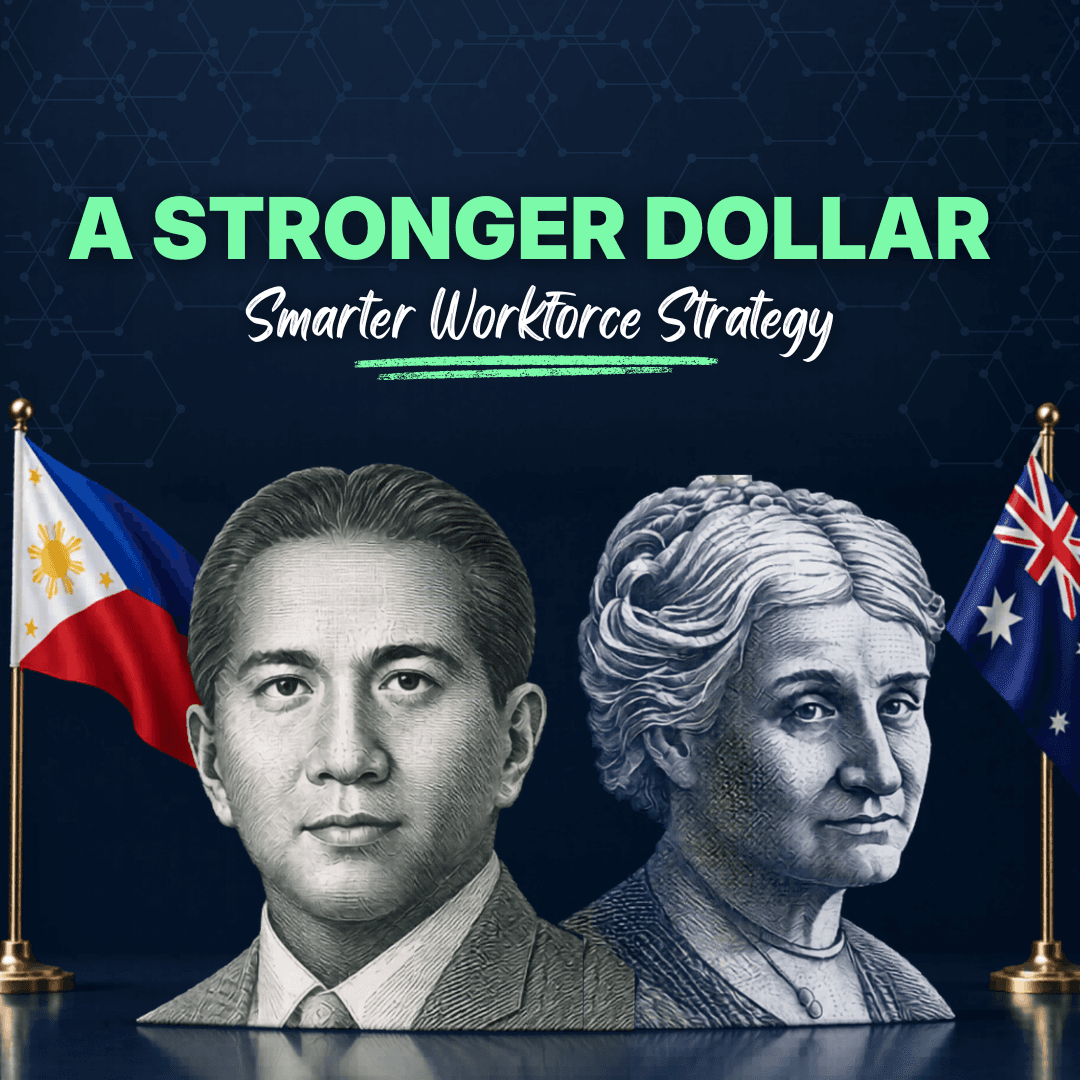
How Australian Businesses Are Maximising Operational Budgets Through Offshore Hiring
For many Australian SMEs, the last few years have been defined by rising operational costs, tighter margins, and increasing pressure to do more with less.
Hiring has become one of the biggest pressure points.
Local salary expectations continue to rise, competition for skilled talent remains high, and businesses are being forced to rethink how they scale without overextending financially. But while many companies are focused on cutting costs, others are taking a more strategic approach:
They’re rethinking workforce structure altogether.
And right now, one factor quietly creating a major advantage for Australian businesses is the foreign exchange (FX) market.
The AUD Advantage Businesses Are Starting to Notice
Over the past five years, the Australian Dollar (AUD) to Philippine Peso (PHP) exchange rate has experienced noticeable fluctuations, but 2026 has marked a significant shift.
The AUD has strengthened sharply against the PHP, crossing the ₱44 range in early 2026. Compared to early 2025 levels, the currency has appreciated by approximately 23.1% year-on-year, creating stronger purchasing power for Australian businesses operating with offshore teams in the Philippines.
To put that into perspective, the AUD averaged:
Around ₱36.9 in 2021
₱38.3 in 2022
₱37.1 in 2023
₱37.5 in 2024
₱37.0 in 2025
Today’s rate sitting near the ₱44 mark represents one of the strongest positions Australian businesses have seen in years.
While exchange rates naturally fluctuate over time, the current market conditions are creating a rare operational advantage for SMEs looking to scale more efficiently.
Why This Matters Beyond Currency Numbers
For many businesses, FX discussions sound like something reserved for finance teams or economists.
But in reality, exchange rates directly impact operational buying power, especially for businesses leveraging offshore staffing models.
Simply put, Australian businesses are currently able to extract more value from their staffing budgets than they could in previous years.
In practical terms, this means:
The same hiring budget can stretch further
Businesses may be able to expand teams faster
Operational support becomes more accessible
Growth initiatives become easier to fund without increasing overhead at the same pace
And in a market where businesses are under pressure to remain lean while still growing, that flexibility matters.
Offshore Hiring Has Evolved Beyond Cost-Cutting
There was a time when offshore staffing was viewed purely as a way to reduce expenses.
That mindset has evolved significantly.
Today, offshore teams are increasingly embedded into core business operations across:
Marketing
Customer support
Administration
Finance
Creative
Sales support
Operations
Technical and specialised roles
The businesses seeing the strongest outcomes are not simply outsourcing tasks.
They’re building scalable operational ecosystems that allow local teams to focus on strategy, client relationships, and growth-driving initiatives.
The result is often a more agile business model with greater resilience during uncertain economic periods.
Why Timing Matters Right Now
What makes the current environment particularly notable is the speed of the recent currency movement.
After a relatively steady period between 2021 and 2025 - where the AUD generally traded within the ₱36 to ₱39 range - 2026 saw a sharp breakout past ₱44.
That shift has materially changed offshore staffing economics for Australian businesses.
For SMEs, this creates a strategic window to:
Increase operational capacity
Improve cash flow efficiency
Build support infrastructure before scaling locally
Reduce pressure on internal teams
Invest savings into revenue-generating initiatives
Market conditions rarely stay static.
Exchange rates move. Labour markets shift. Costs change.
Businesses that act early during favourable market conditions are often the ones best positioned when conditions eventually tighten again.
Smart Budgeting Isn’t About Spending Less, It’s About Allocating Better
The strongest businesses are not always the ones making the biggest cuts.
They’re the ones making smarter allocation decisions.
That may look like:
Keeping leadership and high-touch client roles local
Building offshore operational support teams
Creating hybrid workforce structures
Expanding capability without dramatically inflating fixed costs
For many Australian SMEs, offshore hiring is no longer a reactive decision tied purely to cost savings.
It’s becoming a long-term workforce strategy designed around scalability, flexibility, and sustainable growth.
The Bigger Opportunity for SMEs
The conversation around offshore staffing is changing.
It’s no longer simply:
“How can we reduce costs?”
It’s increasingly:
“How can we build a smarter business model in today’s market?”
The current FX environment is giving Australian businesses an opportunity to revisit workforce planning from a strategic perspective, not just a financial one.
And with the AUD currently sitting at some of its strongest levels against the PHP in recent years, many SMEs are recognising that the businesses who move early may be the ones best positioned for the years ahead.

Shanyl Emeliano
Marketing Head
Comments